


The best air purifier for dust allergy in India (2026) wins on math, not marketing. Dust CADR, filter economics, and room fit decide everything, and any HEPA air purifier India shoppers shortlist must clear all three. Indian homes fight a specific enemy: fine dust that resettles on shelves hours after sweeping, pushes indoor air quality down, and keeps allergens circulating through bedrooms all night. Morning sneezing fits and dusty odours follow. A matched air purifier for home use breaks that cycle.
This 2026 list ranks seven models by room size, budget, and allergy severity. AQI intrusion, running costs, and verified filtration grades shaped every pick. Three decision metrics run through each review: dust-specific CADR, yearly filter cost in ₹, and honest room-size matching.
Best Air Purifiers for Dust Allergy in India 2026: Overview
- Coway Airmega 150 (AP-1019C) — Best Overall: strongest dust CADR per rupee plus India’s widest service network in this list.
- Jafanda JF260S — Best Value for Large Rooms: H13 filtration and high coverage per rupee.
- LEVOIT Core Mini — Best for Small Rooms & Bedside Use: 25 dB whisper operation at an entry-level price.
- Philips AC0920 — Best Smart Purifier for Bedrooms: ~20 dB sleep mode and a live PM2.5 readout.
- Honeywell Air Purifier for Home & Office — Best for Home & Office Use: built for continuous all-day duty.
- Winix 5500-2 — Best for Heavy Dust & Large Rooms: the highest dust CADR here, with washable filter stages.
- Xiaomi Smart Air Purifier 4 Lite — Best Budget Smart Purifier: ~360 m³/h CADR at a budget-friendly price.
Comparison Table
| Model | Best For | Dust CADR (m³/h) | Coverage Area (sq ft) | HEPA Grade | Noise (dB) | Filter Cost/Year (INR) |
| Coway Airmega 150 | Overall | ~300 | ~355 | True HEPA | 22–49 | ~2,500 |
| Jafanda JF260S | Large-room value | ~320 | ~430 usable | H13 True HEPA | 23–54 | ~2,200 |
| LEVOIT Core Mini | Small rooms | ~70 | ~178 | 3-in-1 HEPA | 25–44 | ~1,200 |
| Philips AC0920 | Bedrooms | ~250 | ~380 | H13-grade NanoProtect | 20.5–50 | ~2,800 |
| Honeywell Home & Office | All-day runs | ~250 | ~388 | H13 HEPA | 29–52 | ~2,500 |
| Winix 5500-2 | Heavy dust | ~410 | ~360 | True HEPA | 28–55 | ~4,500 |
| Xiaomi 4 Lite | Budget smart | ~360 | 270–460 | High-efficiency HEPA class | 33–61 | ~1,800 |
Related: Best Air Purifiers in India: Top Picks for Clean Air, How Can I Purify Air Naturally at Home in India
How We Chose These Air Purifiers
The method: spec-sheet analysis across 20+ models sold in India, certification checks, dust-CADR-to-room-size math, three-year filter costing, and a service-network verification pass for every brand.
Scoring followed fixed weights. Filtration for dust: 40%. Running cost: 20%. Noise: 15%. Coverage: 15%. Reliability and service reach: 10%.
Two filters decided eligibility before scoring began. Every model needed True HEPA-grade filtration rated for 0.3-micron particles, and every model needed a realistic path to genuine replacement filters in India. Units that failed either check dropped out, regardless of price or popularity.
The coverage math uses air changes per hour (ACH) — how many times a purifier cycles a room’s full air volume in sixty minutes. Allergy guidance commonly targets four to five. Every “coverage” figure in this list reflects that standard, not the inflated one-change-per-hour numbers printed on boxes. Where a brand published only CFM ratings, conversions to m³/h use the standard 1.7 multiplier.
Do Air Purifiers Actually Help With Dust Allergy?
Yes, with one honest limit. Do air purifiers help with dust mites and household dust? They capture the fine airborne fraction: resuspended dust, pet dander, and pollen that float for hours and trigger asthma and sneezing. They cannot touch dust already settled on bedding, sofas, and floors.
The physics explains why. Dust mite allergen particles measure 10–40 microns and sink fast. Sweeping, walking, and making the bed launch them back into the air. A purifier’s fan and HEPA media trap that resuspended cloud before it reaches your nose. According to the EPA, portable air cleaners can meaningfully cut indoor particle levels, and allergists treat them as one layer of dust control — never the only layer.
India’s context raises the stakes. CPCB monitoring data consistently flags PM2.5 as the lead pollutant across most Indian cities, and fine outdoor particles seep indoors through windows, doors, and gaps. Choosing an air purifier for dust mites and dust allergy therefore addresses both indoor and outdoor triggers at once.
Set expectations honestly. Consistent dust allergy relief typically takes two to four weeks of continuous running. Pair the machine with weekly hot-water bedding washes, vacuuming, and wet dusting. It complements those habits. It never replaces them.
Related: How Many Hours to Run an Air Purifier Daily in India? 24/7 vs. Eco Mode, Do Air Purifiers Remove Smells in India?, How Air Purifiers Work: HEPA, Carbon & UV Explained
How to Choose an Air Purifier for Dust Allergy
1. Buy True HEPA, Reject “HEPA-Type”
Demand H13 HEPA or H14 media with a stated capture rate of 99.97% at 0.3 microns. That figure is the entire game for allergy buyers. Brands disguise weaker filters behind phrases like “HEPA-like,” “HEPA-style,” and “HEPA filtration technology” — none of these guarantee the 99.97% threshold.
On Indian listings, check the specification table for the exact percentage and micron rating, not the marketing bullets. A genuine H13 HEPA air purifier for allergy sufferers states both numbers plainly. A three-stage setup should also include an activated carbon filter for odours and cooking fumes.
2. Match Dust CADR to Your Room Size
CADR (Clean Air Delivery Rate), measures how fast a purifier cleans air, in cubic metres per hour. The math stays simple. A 150 sq ft bedroom with an 8-ft ceiling holds roughly 34 m³ of air. Five air changes per hour demand a dust CADR of at least ~170 m³/h. Buy below that line and the machine runs forever without catching up.
Buy at or above it and allergy symptoms ease measurably. Run the same calculation for your own room: floor area × ceiling height × 5, converted to cubic metres.
3. Check Noise Before Anything Else for Bedrooms
Noise level (dB) decides whether a bedroom purifier stays on or gets switched off in a week. Under 25 dB suits light sleepers — that sits below a whisper. Between 25–35 dB matches a ceiling fan on low.
Above 50 dB at top speed, most people tolerate the unit only in living rooms. Prioritise a dedicated sleep mode with dimmed or disabled display lights. A purifier you switch off at night delivers zero allergy benefit.
4. Calculate Filter Replacement Cost Upfront
The filter replacement cost matters more than the sticker price. Budget HEPA sets run ₹1,200–₹2,000 yearly in India. Mid-range brands charge ₹2,500–₹3,000. Premium imported filters cost ₹4,500. An entry-level purifier needing ₹4,000 filters every year costs more over three years than a mid-range unit with ₹2,000 filters.
Do this division before checkout: filter price ÷ months of rated life = your real monthly ownership cost. That single number separates bargains from traps in the air purifier running cost in the Indian equation.
5. Look for Certifications That Actually Exist
Three certifications carry real weight for allergy claims: AHAM Verifide (independently measured CADR), ECARF (European allergy research certification), and the asthma & allergy friendly mark. Everything else — generic “anti-bacterial” badges, invented lab logos — decorates the box without verifying anything.
For electrical safety, check standard compliance marks on the rating label. A certified unit proves its numbers. An uncertified unit merely claims them.
6. Treat Ionizers and Ozone With Caution
An ionizer charges particles so they clump and settle; some designs emit trace ozone as a byproduct. Ozone irritates airways — the exact opposite of what allergy and asthma buyers need. The rule stays simple: if a purifier includes an ionizer, confirm it can be switched off independently.
Mechanical filtration (fan plus HEPA), does the real work in every model on this list. Ionization remains an optional garnish, never the main course.
Related: How Often to Change Air Purifier Filters in India, Can We Open Windows with an Air Purifier Running?, True HEPA Filter vs HEPA Filter: The Difference Explained
The 7 Best Air Purifiers for Dust Allergy in India 2026
1. Coway Airmega 150 (AP-1019C) — Best Overall for Dust Allergy

Key Specifications
| Model | Dust CADR | Coverage | Filtration | Noise | Power | Filter Life | Warranty |
| Coway Airmega 150 | ~300 m³/h | ~355 sq ft | Pre-filter + Carbon + True HEPA | 22–49 dB | ~35 W | ~8,500 hrs (~12 months) | 1 yr (+5 yr motor) |
The Airmega 150 does exactly what the best air purifier for dust allergy in India must do: move enough clean air, cheaply, for years. Its ~300 m³/h dust CADR delivers four to five air changes per hour in a typical 250–300 sq ft Indian bedroom — the rate allergists commonly recommend for symptom relief. Coway’s True HEPA media traps 99.97% of 0.3-micron particles per manufacturer specs, covering resuspended dust, dander, and pollen in one pass.
Ownership math favours it further. Filters last up to ~8,500 hours — nearly double some rivals—and cost roughly ₹2,500 a year. The 22 dB low speed disappears into bedroom silence; the 49 dB top speed suits daytime bursts only. Coway operates India’s widest service network among these seven brands, which matters in year three when lesser brands stop answering.
The trade-offs are deliberate: no PM2.5 display, no app, no smart scheduling. You get filtration-per-rupee and service reach instead of screens. Best for: most dust-allergy homes wanting set-and-forget reliability. Skip if: live air-quality readings top your list.
Pros
- Strong dust CADR for its price
- Genuine True HEPA filtration
- Long ~8,500-hour filter life
- Whisper-quiet 22 dB low speed
- Simple one-touch operation
Cons
- No PM2.5 display
- No app or smart features
- 49 dB top speed audible at night
- Filter cost sits mid-range
2. Jafanda JF260S — Best Value for Large Rooms

Key Specifications
| Model | Dust CADR | Coverage | Filtration | Noise | Power | Filter Life | Warranty |
| Jafanda JF260S | ~320 m³/h class | ~430 sq ft usable | H13 True HEPA + Activated Carbon | 23–54 dB | ~45 W | 6–12 months | 1+1 yr |
The JF260S is the anti-allergy air purifier pick for buyers who need large-room coverage without investment-tier pricing. The comparison settles it: ~320 m³/h of CADR at a mid-range price undercuts the Winix 5500-2’s cost per m³/h by roughly 28%. That coverage-per-rupee gap matters in 400+ sq ft halls where undersized purifiers run endlessly without catching up.
The feature list punches above the price band. H13 True HEPA media handles the allergen fraction, a numeric PM2.5 display provides the verification loop usually reserved for premium brands, and a 23 dB sleep floor undercuts even some bedroom specialists. Child lock and timer functions round out family use.
The risks sit outside the machine. Jafanda remains a young brand in India: the service network is thin, and long-term filter supply unproven beyond the current listings. Best for: large rooms where budget rules. Skip if: guaranteed long-term service support matters most.
Pros
- Large-room CADR at mid-range price
- H13 True HEPA media
- Numeric PM2.5 display
- Quiet 23 dB sleep floor
- Child lock and timer included
- Best coverage-per-rupee in class
Cons
- Thin service network
- Smaller spares ecosystem
- Brand track record still short
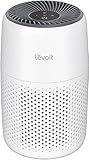
3. LEVOIT Core Mini — Best for Small Rooms & Bedside Use
Key Specifications
| Model | Dust CADR | Coverage | Filtration | Noise | Power | Filter Life | Warranty |
| LEVOIT Core Mini | ~70 m³/h class | ~178 sq ft | 3-in-1 (Pre-filter + HEPA + Carbon) | 25–44 dB | 7 W | 6–8 months | 2 yr |
The Core Mini does one job with precision: cleaning the air immediately around a bed, study desk, or nursery in rooms under 180 sq ft. Within that boundary, it performs admirably — the 3-in-1 filter captures the resuspended dust that triggers morning sneezing, and the 25 dB low speed sits below whisper level for light sleepers.
Ownership costs stay minimal. Seven watts of power draw adds barely ₹30–40 to a monthly electricity bill at continuous use, and replacement filters at ~₹1,200 yearly are the cheapest on this list. The built-in aroma pad doubles as a fragrance diffuser for buyers who want it.
State the limit plainly: this unit cannot serve a living room, and buying it for one wastes money. The small filter also clogs faster in high-dust cities, pulling the replacement interval toward six months. The honest scoping is deliberate — an entry-level purifier matched to the right room beats a mismatched mid-range unit every time. Best for: bedside tables, study desks, and nurseries under 180 sq ft. Skip if: any target room larger than a bedroom.
Pros
- Whisper-quiet 25 dB low speed
- Compact bedside footprint
- 7 W draw costs pennies monthly
- Aroma pad included
Cons
- Small rooms only (~178 sq ft)
- Cannot serve living rooms
- No PM2.5 sensor or auto mode
- No app, timer, or scheduling
4. Philips AC0920 — Best Smart Purifier for Bedrooms

Key Specifications
| Model | Dust CADR | Coverage | Filtration | Noise | Power | Filter Life | Warranty |
| Philips AC0920 | ~250 m³/h | ~380 sq ft | NanoProtect HEPA (H13-grade) + Carbon | 20.5–50 dB | ~46 W | ~12 months (FY0910 filter) | 2 yr |
The AC0920 is the best air purifier for bedroom in India for buyers who want proof, not promises. Its AeraSense sensor drives a numeric PM2.5 readout on the front panel — allergy sufferers watch particle counts fall after switching it on instead of trusting a marketing claim. That feedback loop also exposes real-world events: the spike when someone sweeps, the climb when windows open.
Philips rates the NanoProtect media at 99.97% capture down to 0.003 microns per brand data — deeper than the standard 0.3-micron benchmark. The 360° air intake pulls dusty air from every direction, so placement flexibility beats front-intake rivals. Sleep mode dips to 20.5 dB, the quietest figure in this list, with display lights dimmed for light sleepers.
Costs deserve attention before checkout. The FY0910 replacement filter carries premium pricing at ~₹2,800 yearly, and ~250 m³/h of CADR trails the Xiaomi 4 Lite — priced in the same budget-friendly tier — on raw speed. Best for: bedrooms, light sleepers, and data-driven buyers. Skip if: your hall exceeds 400 sq ft.
Pros
- Live numeric PM2.5 display
- Quietest smart pick at 20.5 dB
- 360° air intake
- App control with scheduling
- H13-grade NanoProtect media
Cons
- Premium filter pricing (~₹2,800/year)
- Coverage is modest for the tier
- Top speed touches 50 dB
Read More: Best Car Vacuum Cleaners in India: Our Top Picks, Best Robot Vacuum Cleaners in India: Our Top Picks, Best Cordless Vacuum Cleaners in India: All Budgets
5. Honeywell Air Purifier — Best for Home & Office Use

Key Specifications
| Model | Dust CADR | Coverage | Filtration | Noise | Power | Filter Life | Warranty |
| Honeywell Air Purifier | ~250 m³/h | ~388 sq ft | Pre-filter + H13 HEPA + Activated Carbon | 29–52 dB | ~42 W | 9–12 months | 1 yr |
Most bedroom purifiers idle between short bursts. This one runs. Honeywell builds the unit for continuous duty — the exact demand profile of a home office occupied ten hours daily or a family living room serving everyone from morning to midnight. Motor and airflow design rated for all-day operation which separates it from intermittent-use rivals.
The filtration stack covers dust allergy squarely: a pre-filter for hair and visible dust, H13 HEPA for the 0.3-micron allergen fraction, and activated carbon for kitchen odours drifting through shared spaces. Coverage of ~388 sq ft per brand data suits the combined living-dining layouts common in Indian apartments.
The compromises sit in the feature list. No app, no scheduling, no smart home integration — just durable physical controls and a filter indicator. Best for: home offices and shared spaces running long hours. Skip if: app control and scheduling top your priority list.
Pros
- Rated for continuous all-day runs
- H13 HEPA 3-stage filtration
- Wide ~388 sq ft coverage
- Simple, durable physical controls
- Filter-change indicator included
Cons
- No app or scheduling
- Fewer smart features for the tier
- 1-year warranty only
- 52 dB top speed
6. Winix 5500-2 — Best for Heavy Dust & Large Rooms

Key Specifications
| Model | Dust CADR | Coverage | Filtration | Noise | Power | Filter Life | Warranty |
| Winix 5500-2 | ~410 m³/h (243 CFM) | ~360 sq ft at high ACH | Washable pre-filter + washable carbon + True HEPA + PlasmaWave | 28–55 dB | ~70 W | ~12 months | 2 yr |
The 5500-2 posts the highest dust CADR on this list—243 CFM as rated under standard CADR testing. This converts to roughly 410 m³/h of real cleaning speed. Road-facing flats and homes near construction sites need exactly that muscle. Fine dust that reappears on furniture every morning meets a machine that cycles a large room’s air four to five times an hour without straining.
Its washable stages suit Indian conditions specifically. The fine-mesh pre-filter and AOC carbon filter rinse clean, absorbing the heavy dust loads that destroy fixed pre-filters within months. That design choice offsets part of the premium filter pricing over time.
One control matters for allergy households: the PlasmaWave ionizer switches off independently. Do so if anyone at home is ozone-sensitive — mechanical filtration does the real work regardless.
The costs are honest ones. This is the priciest unit here, sitting alone in investment-tier territory, and replacement HEPA sets run ~₹4,500 yearly. Best for: large living rooms and heavy-dust zones. Skip if: your target is a compact bedroom.
Pros
- Highest dust CADR on this list
- Washable pre-filter and carbon stages
- True HEPA rated 99.97% at 0.3 microns
- PlasmaWave ionizer can be switched off
- Auto mode adjusts to particle load
Cons
- Investment-tier pricing
- Costliest filters (~₹4,500/year)
- Bulky footprint
7. Xiaomi Smart Air Purifier 4 Lite — Best Budget Smart Purifier

Key Specifications
| Model | Dust CADR | Coverage | Filtration | Noise | Power | Filter Life | Warranty |
| Xiaomi Smart Air Purifier 4 Lite | ~360 m³/h | 270–460 sq ft | High-efficiency HEPA-class (99.97% @ 0.3 µm) | 33–61 dB | ~33 W | 6–12 months | 1 yr |
The best budget air purifier for dust allergy earns that label through arithmetic. Roughly 360 m³/h of CADR at a budget-friendly price works out to unmatched airflow-per-rupee in this list. The rivals in the same tier deliver ~250 m³/h. For dust-allergy buyers, that gap translates directly: more air changes per hour in the same room, for less money.
Smart features arrive intact despite the tier. The OLED touch display shows PM2.5 readings, and the Mi Home app plus Alexa and Google voice control enable scheduling, remote starts, and automation routines that usually demand mid-range money. Replacement filters at ~₹1,800 yearly are the cheapest among the big-room picks, with wide online availability.
Accept the honest trade-offs. The 33 dB minimum speed runs louder than Philips’ 20.5 dB sleep mode — light sleepers should test before committing. The onboard particle sensor trails Philips’ AeraSense for accuracy, and Xiaomi labels the filter “high-efficiency” rather than certified H13/H14. Best for: first-time buyers and mid-size rooms on strict budgets. Skip if: bedroom silence below 30 dB is non-negotiable.
Pros
- Best CADR-per-rupee on this list
- OLED touch display with PM2.5
- App, Alexa, and Google control
- Cheapest big-room filters (~₹1,800/year)
- Wide 270–460 sq ft coverage
- Easy filter availability online
Cons
- 33 dB floor loud for light sleepers
- Sensor accuracy trails Philips
- Plasticky build feel
- 1-year warranty
Which Air Purifier Should You Buy?
Which air purifier is best for dust allergy depends on your room and budget — match yours below:
- Bedroom under 150 sq ft: LEVOIT Core Mini or Philips AC0920
- Large living room: Winix 5500-2 or Jafanda JF260S
- Tight budget with smart features: Xiaomi 4 Lite
- Severe allergy, long-term reliability first: Coway Airmega 150
Read More: Best Stabilizers for AC in India: Our Top Picks, Best Portable Air Coolers in India: Our Top Picks, Best Steam Irons for Clothes in India: Our Top Picks
3-Year Ownership Cost (Price Tier + Filter Replacements)
| Model | Price Tier | Filters Over 3 Yrs (₹) | Ownership Verdict |
| LEVOIT Core Mini | Entry-level | ~2,400 | Lowest total spend on this list |
| Xiaomi 4 Lite | Budget-friendly | ~3,600 | Cheapest big-airflow ownership |
| Honeywell Home & Office | Budget-friendly | ~5,000 | Low tier, mid filter cost |
| Coway Airmega 150 | Budget-friendly | ~5,000 | Balanced; long filter life helps |
| Philips AC0920 | Budget-friendly | ~5,600 | Filter premium shows over time |
| Jafanda JF260S | Mid-range | ~4,400 | Strong value if filter supply holds |
| Winix 5500-2 | Investment tier | ~9,000 | Highest spend, highest CADR |
The table rearranges the ranking. Winix cleans the most air but costs the most to own. Xiaomi and Honeywell quietly win the three-year math for their coverage classes.
Placement & Usage Tips for Maximum Relief
Where to place the air purifier for dust allergies matters as much as which one you buy. Follow these rules:
- Put the unit in the bedroom first — you spend a third of life there.
- Keep it 3–6 feet from the bed, at breathing height where possible.
- Leave a foot of clearance from walls and curtains. Blocked intakes halve performance.
- Run it 24×7 on auto mode. Minimum effective dose: two hours before sleep.
- Shut windows during high-AQI days and dusty afternoons.
- Pair the machine with weekly hot-water bedding washes and regular vacuuming.
Maintenance & Filter Replacement
Wash the pre-filter monthly — Indian dust loads clog them faster than the manuals assume. Replace HEPA media on schedule: roughly 8–12 months for most models here, sooner in high-dust cities. Buy genuine filters only; third-party copies fit the slot but miss the 0.3-micron rating.
Watch for the three failure signs: a stale odour from the outlet, visibly weaker airflow, and the filter indicator light. Any one of them means the machine has stopped cleaning and started recirculating.
Read More: Split AC vs Window AC: 8 Differences That Matter in India, Air Cooler vs AC: Which One Should Cool Indian Homes?, Air Purifier Vs Humidifier: Differences and What You Should Know
Final Verdict
Three picks settle the decision. The Coway Airmega 150 takes overall honours on filtration-per-rupee and service reach. The Xiaomi 4 Lite wins budget. The Winix 5500-2 owns large rooms. Choosing the best air purifier for dust allergy in India reduces to one rule: match the dust CADR to your room size first, then check the filter cost. Everything else is preference.
Frequently Asked Questions (FAQs)
The Coway Airmega 150 is the best air purifier for dust allergy in India for most homes — it combines a ~300 m³/h dust CADR, True HEPA filtration, ~₹2,500 yearly filter cost, and the widest service network among these seven picks. Large rooms suit the Winix 5500-2; tight budgets suit the Xiaomi 4 Lite.
Partially. Dust mites live inside bedding, mattresses, and upholstery — no purifier reaches them there. What a purifier does capture: the airborne allergen particles (10–40 microns) that disturbances launch into the air. Pair the purifier with weekly hot-water bedding washes for real relief.
For dust particles, yes — H13 True HEPA captures 99.97% at 0.3 microns, which covers dust, dander, and pollen. Add an activated carbon layer if odours or cooking fumes also bother you. Ensure the purifier body seals properly so air cannot bypass the filter.
Bedroom first, 3–6 feet from your bed, away from walls and curtains. Keep windows closed while it runs. Living-room placement comes second for daytime relief. Never tuck the unit behind furniture — blocked airflow cuts cleaning speed dramatically.
Ideally 24×7 on auto mode — particles re-enter constantly. At minimum, run it two hours before sleep and through the night. Electricity cost stays modest: a 40-watt unit running continuously adds roughly ₹150–₹250 per month to a typical Indian power bill.
Pure mechanical purifiers — fan plus HEPA — produce zero ozone. Models with ionizers or plasma features can emit trace amounts. Check for a disable switch before buying; every ionizer on this list (including Winix’s PlasmaWave) can be turned off. Allergy and asthma households should do exactly that.
Budget ₹150–₹250 monthly for electricity at continuous use. Add yearly filter replacements: ₹1,200 for compact units like the LEVOIT Core Mini, ₹1,800–₹2,800 for mainstream models, up to ₹4,500 for premium imports like the Winix 5500-2. Over three years, filters drive most of the ownership-cost gap between entry-level and investment-tier picks.
Disclaimer: This article contains affiliate links. If you purchase a product through these links, we may earn a small commission at no extra cost to you. This helps us support our research and writing. We only recommend products we genuinely believe in. Please note that we have not been given any free products, services, or anything else by the brands in exchange for mentioning them on the site.